
Where the Rivers Remember
Part 1: Peoples, Power, and the Bosnian Land

The collapse of the Avar Khaganate did not produce order. It produced a vacuum and vacuums in the Balkans had a well-established tendency to be filled slowly, violently, and incompletely. Between the final Frankish campaigns against the Avars in 796–803 AD and the first written mention of a place called Bosona in the mid-10th century, the territory that would become medieval Bosnia existed in a state that resists the clean political labels later historians would attempt to assign it. It was Slavic in population, contested in sovereignty, and defined — if it could be called defined at all — by rivers.
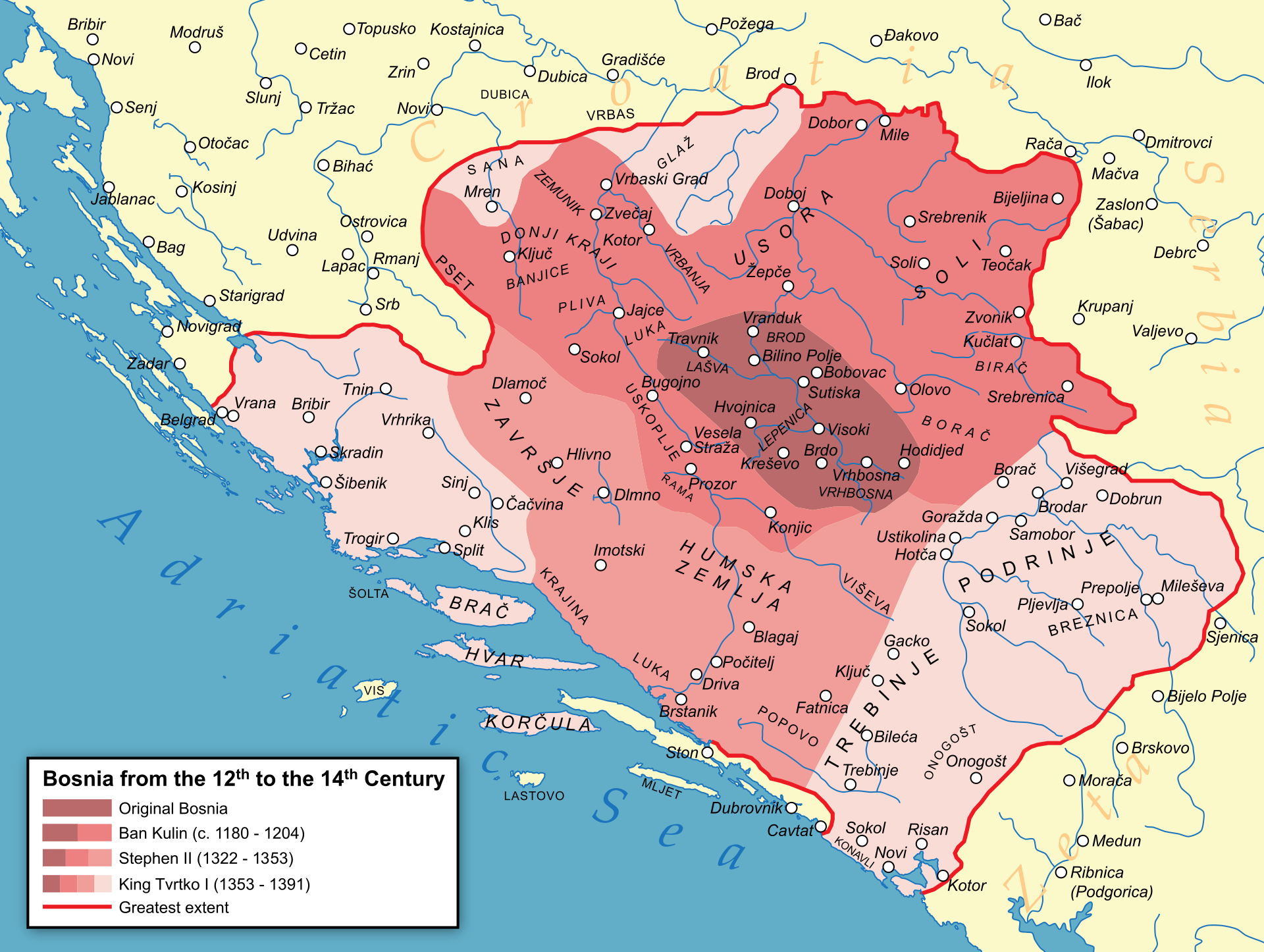
The Landscape After the Avars
The Frankish campaigns under Charlemagne, which culminated in the destruction of the Avar ring-fortresses (hrings) between 791 and 803 AD, effectively ended centralized Avar political authority in the Pannonian basin and the surrounding upland territories. What remained was a patchwork of Slavic tribal groupings — some of which had been Avar clients, some of which had actively rebelled against the Khaganate under Samo and later in the fragmentation period of the 630s–660s, and some of which had simply survived on the geographic margins of Avar power.
The territory between the Sava River to the north, the Drina River to the east, the Neretva River to the south, and the Una River to the west — roughly the geographic core of what would eventually be called Bosnia — sat at one of those margins. The Avars had exercised dominance over the Pannonian lowlands, but the Dinaric highlands to the south and east presented logistical challenges that consistently limited the depth of Avar administrative penetration. The Slavic groups that settled these highland župas were therefore somewhat insulated from the full weight of Avar control, which had meaningful implications for how they emerged after 796 AD: relatively intact as social units, but without a unifying political authority of their own.
The post-Avar Balkans were reorganized, in the loosest possible sense, by three competing external forces: the Frankish Empire to the northwest, the Byzantine Empire to the south and east, and the nascent Bulgarian state, which by the early 9th century was aggressively expanding westward from the Pontic steppe into the northeastern Balkans. None of these powers exercised direct administrative control over the Bosnian highland interior. The Franks held nominal suzerainty over the Croatian Duchy through the mechanism of the marca (march) system and received tribute from Croatian leaders — but their interest diminished sharply as distance from the Adriatic coast increased. The Byzantines maintained coastal footholds in Dalmatia but had effectively withdrawn from the interior. The Bulgarians, under Khan Krum (r. 803–814) and later Presian I (r. 836–852), expanded toward the Morava valley and Macedonia but did not push meaningfully into the central Bosnian highlands during this period.
What filled the space was the župa.
The Župan System and the Reality of Early Slavic Governance
The župa was the fundamental political and social unit of South Slavic organization — a territorial district organized around kinship ties, shared pastureland and agricultural land, and a degree of collective military obligation. Each župa was governed by a župan, a term that appears in Byzantine, Frankish, and later Latin sources, though its precise authority and hereditary character varied considerably between regions and time periods. The župan was not a king and was not an administrator in the Roman sense. The closest analogy, imperfect as all analogies are, is a tribal elder with coercive capacity — a figure whose authority derived from a combination of lineage, military reputation, and the consent of the extended kin groups beneath him.
The territory of early Bosnia was organized into a series of these župas, each with a degree of internal autonomy. Among those that appear in later medieval sources, and which can be projected backward with reasonable confidence into the 9th century, are: Bosna (the central župato, named for the river), Pliva (in the northwest, around the Pliva River), Uskoplje (in the upper valley of the Vrbas), Luka (later divided into Gornja and Donja Luka), and the Rama valley to the south. The Neretva basin and the area later known as Hum (modern Herzegovina) represented a transitional zone with its own župan hierarchy, oriented more toward the Adriatic and more directly contested between Serbian and Croatian spheres of influence. The named župas — Pliva, Uskoplje, Luka, Rama — appear in 12th and 13th century sources: Hungarian royal charters, papal correspondence (particularly letters connected to the heresy campaigns), and the Charter of Ban Kulin (1189 AD), the earliest surviving Bosnian document.
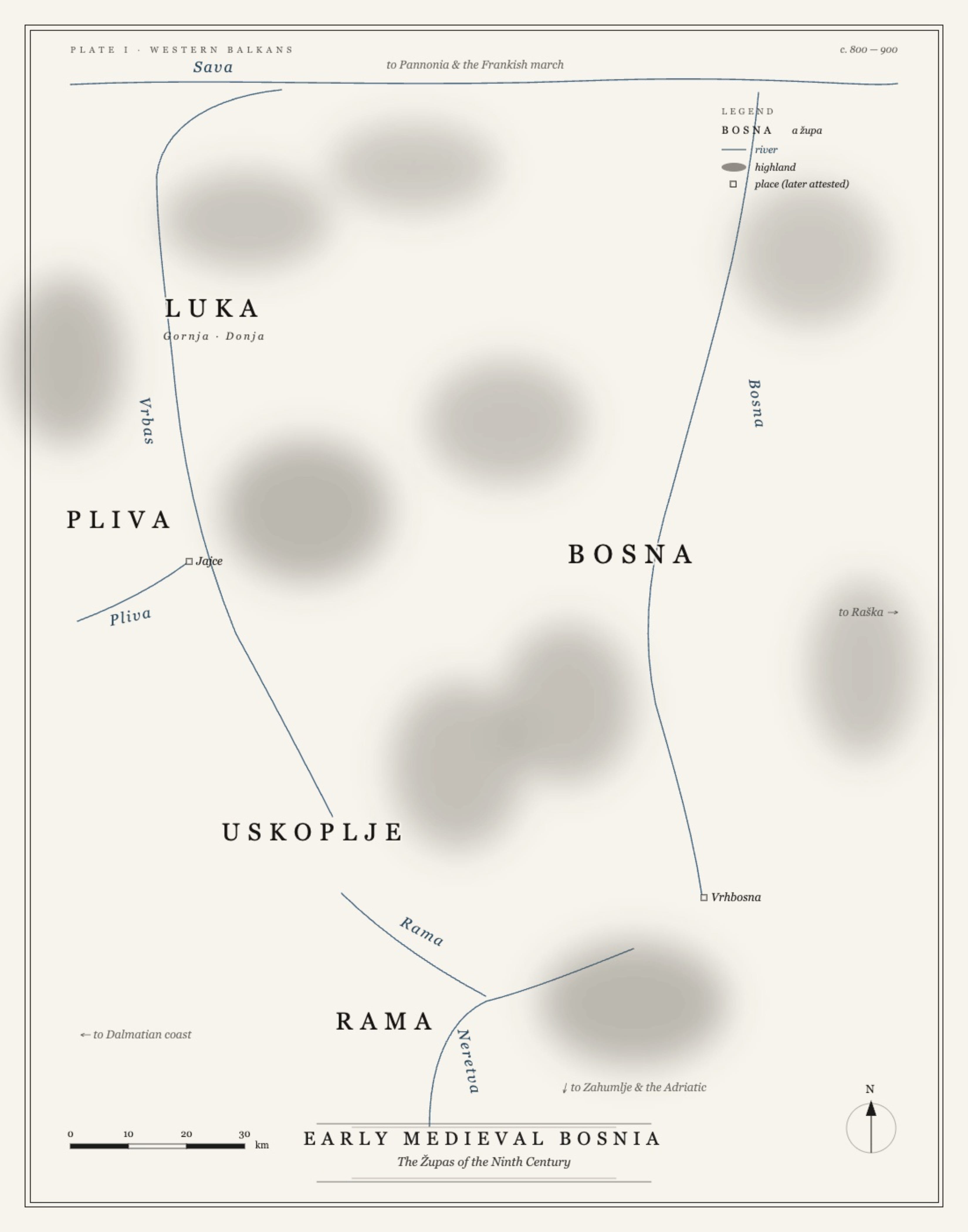
Crucially, these župas did not constitute a state. There was no single župan over all of Bosnia, no common tribute collection, no shared administrative apparatus. The early medieval Bosnian highlands were a geographic expression — defined by the watershed of the Bosna River — more than a political one. The river named the land; the land did not yet name a people.
Frankish Influence and it’s Limits
The Frankish reorganization of the post-Avar western Balkans was implemented primarily through two mechanisms: the installation of compliant Croatian and Pannonian Slavic leadership as tributaries, and the aggressive promotion of Latin Christianity through the ecclesiastical network centered on Aquileia and, on the Dalmatian coast, Split (Salona’s successor city). The Council of Mainz in 813 AD explicitly addressed the Christianization of the Slavic populations on the eastern Frankish frontier, and subsequent decades saw a concerted missionary effort push southward and eastward through the Croatian Duchy into the Slavic interior.
The Frankish interest in Bosnia specifically, however, was attenuated by the same geographic reality that had limited Avar penetration: the karst terrain, dense forests, and river canyon systems of the Dinaric highlands made them difficult to administer and expensive to garrison. The Bosnian župas were not brought formally into the Carolingian administrative system. They appear to have acknowledged Frankish suzerainty indirectly — through the Croatian Duchy’s own acknowledgment of Frankish overlordship — but this was tribute-chain politics rather than direct governance. When the Frankish Empire itself began to fragment following the Treaty of Verdun in 843 AD, which divided Charlemagne’s realm among his three grandsons, the tenuous Frankish reach into the Bosnian interior effectively dissolved.
In its place, the Croatian Duchy — now operating with increasing autonomy — and the Serbian principality, which was consolidating under Vlastimir (r. approximately 830–850 AD) along the Drina and Ibar river valleys, began pulling the Bosnian župas into their respective gravitational fields. This would establish a tension between western and eastern orientation in the region that persisted, in various forms, for centuries.
Bosona: The First Written Attestation
The first unambiguous written record of Bosnia as a named territory appears in De Administrando Imperio, the political and geographical treatise compiled by Byzantine Emperor Constantine VII Porphyrogenitus around 948–952 AD. His reference to Bosnia is brief but historically significant:
“In the baptized Serbia are included the inhabited cities of Destinikon, Tzernabouskeï, Megaretos, Dresneïk, Lesynika, and Salines. In the baptized land of the Bosnans (χώρα Βοσώνα) are the cities of Katera and Desnik.”
Constantine describes Bosona as a chora — a territorial unit, roughly translatable as “land” or “country” — with precisely two inhabited settlements of note. Katera is generally identified by scholars with Kotor na Plivi, and Desnik has been tentatively placed in the upper Bosna valley, though neither identification is definitive. Two cities does not constitute a state.
Constantine places Bosona within the geographical context of baptized Serbia — the implication being that Bosnia was understood by the Byzantine court as a subordinate territorial unit within the broader Serbian sphere, at least at the moment of writing. This does not mean that the inhabitants of Bosnia were “Serbs” in any ethnic or self-identifying sense; it means that the Byzantine administrative gaze, looking westward from Constantinople, grouped the Bosnian župas within the Serbian principality’s zone of influence. Whether that grouping reflected political reality on the ground or Byzantine imperial wishful thinking is a question the surviving sources cannot fully resolve.
The name itself. Bosona is almost certainly derived from the Bosna River, which in turn appears to preserve a pre-Slavic hydronym — a place name older than the Slavic migration itself. The linguistic root has been proposed as Illyrian, proto-Celtic, or broadly Indo-European, connected to a root meaning “running water.” The river named the region before the Slavs arrived; the Slavs inherited the name.
The Political Map, 838-950 AD
The 838 AD reference point that closes Part 7 places the nascent Bosnian territory at a specific moment in the regional political configuration: the Croatian Duchy under Mislav was consolidating its autonomy from Frankish overlordship while managing the emerging Bulgarian threat from the east; the Serbian principality under Vlastimir was in the early stages of the resistance against Bulgarian expansion that would define mid-9th century Balkan politics; and the First Bulgarian Empire under Presian I was pushing aggressively westward, ultimately clashing with both the Serbs and the Macedonian frontier.
Bosnia, occupying the highland interior between these forces, appears in this period as a buffer and a corridor rather than as a protagonist. The Drina River functioned as a rough boundary between Serbian and Croatian spheres — a boundary that was permeable and contested rather than fixed. By the time of the Serbian principality’s greatest 9th-century consolidation under Mutimir (r. approximately 851–891 AD), Byzantine diplomatic sources suggest that certain župas in the Bosnian region were acknowledging Serbian overlordship — not as annexed territories, but in the loose tributary relationship typical of župan-level politics. This is not the same as being “part of Serbia.” It is the kind of acknowledgment that could be withdrawn, redirected, or ignored depending on the relative strength of the overlord at any given moment.
The late 9th century added a further complicating variable: the Magyar migration. The Magyars, a Finno-Ugric steppe people pushed westward by Pecheneg pressure, crossed the Carpathians and settled the Pannonian plain definitively by 895–896 AD. For the Bosnian highlands, Magyar settlement of Pannonia reinforced geographic isolation — the mountains to the south and west were already formidable barriers, and now the Pannonian gateway to the north was controlled by a new and formidable power. This isolation would prove to be one of the defining characteristics of Bosnian political development: the highlands were easy to retreat into and difficult to hold.
The Question of the Ban
The title of ban — the office around which so much Bosnian nationalist historiography has constructed its foundational narrative — requires careful contextualization before it can be applied to the early medieval period at all.
The word ban itself is of uncertain but almost certainly non-Slavic origin. The leading etymological hypotheses connect it to an Avar or Turkic root, possibly derived from a title used within the Avar administrative hierarchy for subordinate governors of non-Avar peoples. The title itself appears in Frankish sources in connection with the Croatian Duchy by the early 9th century, where the ban functioned as a subordinate ruler beneath the Croatian dux or duke — effectively a regional governor of the Croatian interior appointed by or answerable to the Croatian ruler.
The first historically attested ban with an explicit Bosnian association is Borić, who appears in Hungarian and Byzantine sources in the 1150s AD — a full two centuries after Bosona enters the written record.
The principal primary source is the Epitome of John Kinnamos, a Byzantine court secretary who served under Emperor Manuel I Komnenos and compiled a history of his reign sometime in the 1180s. Kinnamos mentions Borić in the context of the Byzantine-Hungarian military confrontations of the 1150s, specifically in relation to a campaign of approximately 1154 in which Bosnian forces, under Borić’s command, are described as fighting in alliance with Hungary against Byzantine interests in the Branicevo (Serbia) region. This is the earliest unambiguous appearance of a named Bosnian ban in any surviving written record. Niketas Choniates, writing his own chronicle of the same period somewhat later, corroborates the general picture of Hungarian-Bosnian military cooperation against Manuel I but adds no substantive independent detail about Borić as an individual or about the internal character of his authority. No contemporary Bosnian document survives from his tenure; the earliest extant text produced within Bosnia is the Charter of Ban Kulin, dated 1189 — at least two decades after Borić ceases to appear in the sources.
The context in which Borić emerges in Kinnamos is significant and has not always received the analytical weight it deserves. His appearance in the Epitome is incidental: he is named because he is present at a military engagement that Kinnamos is describing from a Byzantine court perspective, not because Kinnamos has any sustained interest in Bosnian governance or the internal structure of the Bosnian banate. Borić is, in the Byzantine record, a peripheral figure encountered at the margins of a larger narrative about imperial conflict with Hungary. The elevation of this marginal appearance into the founding moment of Bosnian statehood reflects the retrospective needs of later historiography rather than the weight the contemporary sources assign to it.
The political context of the mid-12th century further complicates the interpretation of Borić’s status. Hungary had been extending its influence southward with increasing effectiveness since the late 11th century, formalizing its claim to suzerainty over Croatia from approximately 1102 onward through the Pacta Conventa, a document whose authenticity has been disputed but whose political effects were real. By the mid-12th century, Bosnia fell within the expanding Hungarian administrative orbit. The ban title, as discussed in the preceding section, had entered South Slavic political vocabulary through the Croatian-Hungarian institutional channel and was the standard designation for Hungarian-recognized or Hungarian-appointed frontier administrators throughout the region. Borić’s appearance in Kinnamos as a ban operating in coordination with Hungarian military forces is therefore more consistent with the profile of a frontier administrator functioning within a larger hierarchical system than with that of an independent sovereign exercising authority by right of his own political legitimacy.
Whether Borić was a local župan elevated and formalized through Hungarian recognition, or an administrator of external origin imposed upon the Bosnian župas by Hungarian appointment, cannot be determined from the available evidence. His name is Slavic in formation, which establishes nothing of analytical utility: Slavic nomenclature was pervasive across the entire spectrum of the 12th-century regional population regardless of ethnic or political affiliation. Hungarian magnates, Croatian nobles, and Serbian župans all used Slavic names with regularity by this period. John V.A. Fine Jr., in The Early Medieval Balkans, acknowledges the unresolvable nature of the question of Borić’s origins while noting that the balance of probabilities favors some degree of local grounding; Noel Malcolm, in Bosnia: A Short History, reaches a similar conclusion with similar reservations. Neither can point to a source that identifies where Borić came from or by what mechanism he came to hold his title.
Borić’s documented career ends as abruptly as it begins. Manuel I Komnenos achieved a significant military and diplomatic success against Hungary during the campaigns of the late 1150s and early 1160s, which resulted in a renegotiation of spheres of influence across the western Balkans. Bosnia appears to have shifted temporarily into the Byzantine orbit as part of this realignment, a circumstance that would explain Borić’s disappearance from the sources in the period approximately 1163–1167. Whether this disappearance reflects his death, his removal from office by a shifting political authority, or simply the absence of further documentation is unknown. He is succeeded, after an interval, by Kulin — whose origins are equally obscure but who is at least attested in a document of his own production, the Charter of 1189, which makes him a substantially more concrete historical figure and the first Bosnian political authority whose voice, however formulaic, survives in the written record.
What the source record yields for Borić, taken in its entirety, is the following: one name, one title, one military appearance in a Byzantine court history composed by an author with no particular interest in Bosnia, and a tenure that can be dated only approximately to roughly 1154–1163. The governance structure beneath him, his relationship to the župan hierarchy of the Bosnian highlands, his religious affiliation, and the geographic scope of his effective authority are all unknown. The construction of Borić as the progenitor of Bosnian political identity — a construction visible in historiographical traditions across the region’s competing national narratives — is not supported by the sources. It reflects, rather, the recurring tendency in medieval Balkan historiography to locate foundational moments in figures whose obscurity is precisely what makes them available for foundational use.
The question of whether Borić was “Bosnian” in any meaningful ethnic or political sense, or whether he was Avar, Serb, Croatian or Hungarian-appointed administrator governing a newly important frontier territory, is one the sources do not resolve cleanly.
What can be said with confidence is this: the ban title in Bosnia was not an indigenous Bosnian political invention. It arrived as part of a broader South Slavic — and ultimately Avar-derived — vocabulary of governance, it was used in Croatia before it was used in Bosnia, and when it appears in Bosnia it does so in the context of external powers attempting to define and regularize a territory they did not fully control. The first Bosnian ban was a political instrument before he was a Bosnian political figure and the distinction matters.
Who Inhabited the Land
The genetic picture available for the early medieval Bosnian highlands is less detailed than that available for the Roman-era Balkans discussed in Part 6, largely because the archaeological record for the 7th–10th centuries in the region is fragmentary. High-altitude terrain, acidic soils, and the prevalence of cremation in early Slavic burial traditions have significantly reduced the availability of ancient DNA from this period and this specific geographic zone.
The population of the Bosnian highlands in the 9th–10th centuries was predominantly of Central-Eastern European early medieval Slavic ancestry — consistent with the migration patterns documented in Parts 6 and 7 — with a residual component of Balkan Iron Age ancestry indicating some degree of continuity with pre-Slavic populations. The Illyrian populations of the Bosnian highland interior, already diminished and fragmented by the time of the late Roman period, left a genetic signal in the modern population but not a dominant one.
The settlement archaeology corroborates a picture of small, dispersed communities organized around the župa structure — hilltop fortifications (gradine, many of which repurpose Iron Age or Roman-era foundations), river valley agricultural settlements, and seasonal highland pastures. There is no evidence of urban continuity from the Roman period in the Bosnian interior; the two cities Constantine mentions — Katera and Desnik — were almost certainly fortified župan seats rather than towns in any Roman sense of the word.
What the archaeology does not support is any narrative of ethnic or cultural continuity between the pre-Slavic inhabitants of the Bosnian highlands and the population that Constantine encountered in the 10th century. The settlement patterns changed. The burial practices changed. The material culture changed. The language changed. What persisted were the rivers, the mountains, the mineral deposits, and the names that an older world had given them — inherited, as so much in the Balkans has been inherited, by people who arrived long after those names were first spoken.
The land called Bosona was, by the mid-10th century, a geographic fact and a political ambiguity. It had a name derived from a river whose name preceded the Slavic migration. It had a population whose ancestry was predominantly the product of that migration. It had a župan-based governance structure that was South Slavic in form and Avar in institutional origin. It was claimed, at various moments and with varying credibility, by the Croatian Duchy, the Serbian principality, the Byzantine Empire, and eventually the Kingdom of Hungary. It had been incompletely Christianized by two competing churches and had not yet produced a political structure capable of adjudicating between them.
What it had not yet produced was a ban, a kingdom, a church of its own, or a name for its people. Those would come — slowly, and under pressure from the same competing forces that had defined the territory since the Avar collapse. The process by which they came is the subject of the chapters that follow.